
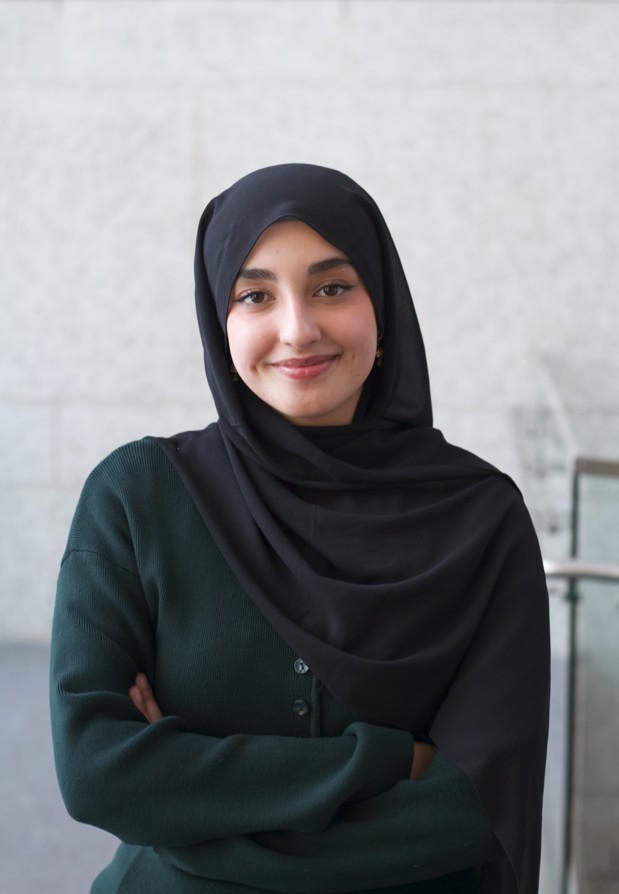
Third-year MD student receives MD Financial Leadership Award
Sundus Zia (she/her), third-year medical doctor (MD) student, was recently awarded the MD Financial Leadership Award at the International Congress on Academic Medicine. She sat down to talk about her winding path into medicine, her contributions to student life and the medical community, and how she plans to continue this work into her medical career.
By Wren MynhardtThe MD Financial Leadership Award is granted to one medical doctor (MD) student from each of the member schools of the Canadian Federation of Medical Students (CFMS). Recipients are selected based on leadership and contributions to student life and improving the medical community. This year, the University of Saskatchewan’s College of Medicine recipient was Sundus Zia, a third-year MD student.
Zia’s contributions to student life include enhancing the medical curriculum and providing mentorship. When it comes to medical curriculum, her research primarily involved examining AI and how working with AI can be integrated into medical teaching.
“Having dedicated time for AI teaching in the curriculum is kind of still unique amongst medical schools,” said Zia. “During my first year, I realized that I had a unique background [with] a computer science degree. I had done some AI research in undergrad, and I really wanted to carry that over into medicine. I could see that a lot of it was being included in medicine already in the clinical field, and so I wanted to see if I could do some research that really spoke to my strengths.”
In order to conduct this research, Zia worked closely with Dr. Scott Adams (MD, PhD) and the AI Working Group. During the course of the project, the working group examined medical schools in Canada and the United States. “[We worked] to get an understanding of what [AI curriculum] already exists and what can we learn from what other people are teaching their students to see if there's a standard that we kind of unconsciously come to,” said Zia.
When asked about the transition from computer science to medical school, Zia shared, “In high school, I was a very shy kid and so even though I loved all the subjects that would make you a strong medical applicant at least academically like biology…the fact that I was really shy scared me away because I realized the importance of people skills in health care. So I applied to computer science instead…and then I ended up really loving it. It was definitely a strength of mine.”
She went on to add, “I fully expected to build a career in computer science. And then COVID hit…after COVID, I realized I would like to work on my people skills…I made a conscious effort to participate in student groups and to get out of my comfort zone.”
This participation in student groups is what increased Zia’s passion for leadership and mentorship. It also eventually led to her developing the people skills she desired for studying medicine.
“Through all those different opportunities, I feel like I got over my shyness,” Zia shared. “Then fourth year comes along…I was talking to a friend of mine and she was like, 'Oh, so what's the plan next? Weren't you going to do medicine?' I started thinking about it and [realized] I feel like I'm going to regret it for the rest of my life if I didn't even try… I started [studying] for the MCAT, and I at each step was like, 'It's okay if I don't make it through; it's fine. There's always next year.’ Then I made it through…I was very, very grateful to have gotten in.”
Reflecting on how others got into medicine, Zia commented, “What I'm learning now, as I speak to more and more students, is how diverse everyone's backgrounds and passions are. And it's always amazing to see how all roads lead to medicine.”
Zia is determined to pursue AI research regardless of her future residency so that she can continue to contribute to the medical community. “AI has a role in every field — not only just as medical professionals but also in our personal lives— it's becoming more and more heavily used…I would love to help develop guidelines for ways we should interact with AI, because I think it would really connect my two interests: the computer science part of it relating to the software, and then also the people in health care that use that software.”
Near the end of the interview, Zia was asked what advice she would give to students who are interested in pursuing research and leadership while in medical school. “I heavily relied on my amazing friends both in medicine and outside of medicine…Have good people that you can talk to about things, who support you and who are happy for your achievements, even more than you are.”
Zia added, “I think having people like that in your life to encourage you is essential. That's why one of my passions is mentorship, because I really don't think I would be where I am today without people who have gone through the process already being like, 'You can do this for sure.’”
For final remarks, Zia was asked how it felt to have her work recognized by the MD Financial Leadership Award. “Med school is constantly go-go-go. As soon as you're done an exam…there's another one coming up. It's really hard to feel like you've accomplished anything,” said Zia. “So getting this award [was] confirmation that my hard work is paying off. It felt really nice. Then I also had everybody at the conference…a lot of my fellow med students, a couple residents and people from the UGME who all made a point to come to the award ceremony and come celebrate it, and so it was another opportunity to see everybody’s support.”
Zia would like to give special thanks to the following individuals for supporting her work and nomination: Dr. Scott Adams, Dr. Zoher Rafid-Ahmed (MD), and Anas Arwini, MD Class of 2027.
For a more in-depth look at Zia’s work in AI research, you can read “Bringing AI into the classroom.”