
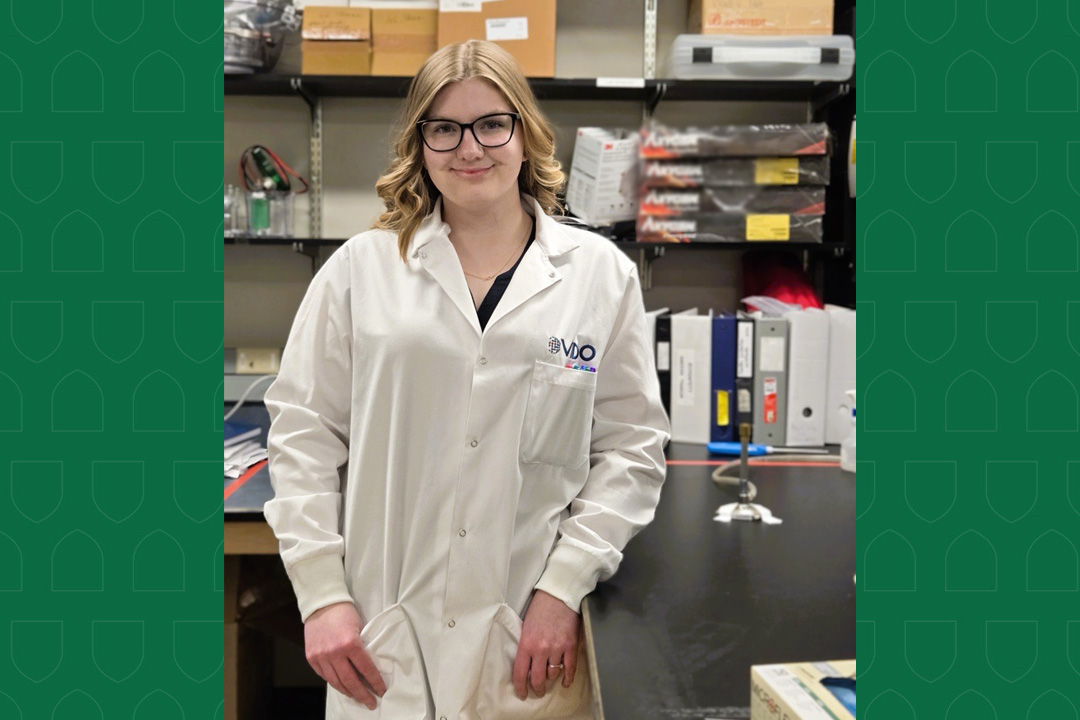
A path to vaccine research
Anna Martens-Koop first became interested in vaccine research while completing her undergraduate degree at the University of Saskatchewan (USask). What began as curiosity quickly grew into a desire to contribute to the field herself.
By Amanda WoroniukNow, Martens-Koop is a PhD student in the Department of Biochemistry, Microbiology and Immunology (BMI) working in the laboratory of immunologist Dr. Aneesh Thakur (PhD), research scientist at the Vaccine and Infectious Disease Organization (VIDO) and BMI adjunct faculty member. Her research focuses on developing vaccines that can activate immune protection in the body’s mucosal surfaces.
We asked Martens-Koop a few questions to learn more about her research, what she enjoys most about being a part of VIDO and her career aspirations after graduation.
Could you tell us about your education background and what inspired you to pursue a PhD?
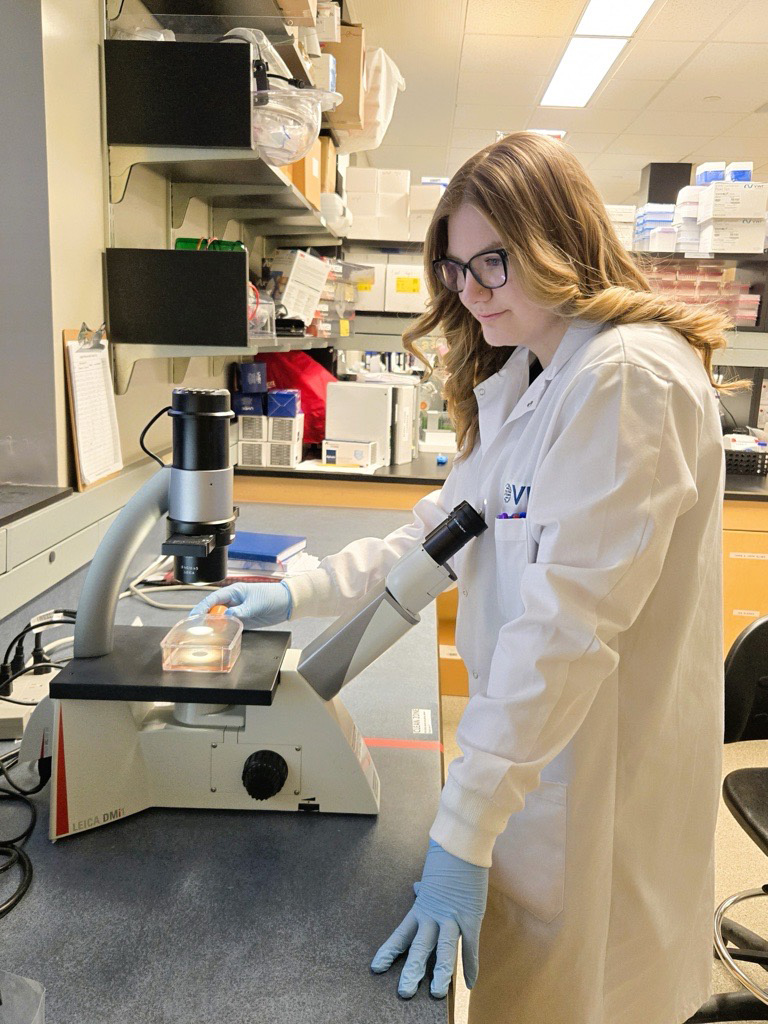
I was born and raised in Saskatoon and have completed all my secondary education through the University of Saskatchewan. In 2023, I completed my Bachelor of Science Honours Degree in Microbiology and Immunology.
My interest in pursuing a PhD developed during my first year of undergrad while taking BMSC 200 with Dr. Scott Napper (PhD). Midway through the course, the COVID-19 pandemic hit, causing a great deal of uncertainty and anxiety globally.
While some students were excited about the possibility of time off, I remember worrying that I wouldn’t get to keep learning. Thankfully, USask transitioned to online classes, and during lectures, Dr. Napper spoke about his ongoing work at the Vaccine and Infectious Disease Organization (VIDO).
Hearing about the real-time scientific efforts to understand and combat infectious diseases during a global crisis was incredibly motivating and his genuine passion for his work was crystal clear. This inspired me to help further the understanding and control of infectious disease, and my perspective shifted from simply wanting to learn about biology to contributing to it.
In the fall of 2023, I began my master’s degree in Biochemistry, Microbiology and Immunology (BMI) and completed one year, before transferring into my PhD program in 2025 and joining the Laboratory of Vaccine Engineering and Immunotherapeutics (LVEI) under the supervision of Dr. Aneesh Thakur (PhD).
My work has focused on vaccine development, which is crucial technology for controlling future pandemics. Although my work may never directly save a life in the way a physician or emergency responder can, I hope to work behind-the-clinical scenes to prevent and reduce the spread of disease on a broad scale.
Would you be able to describe your research and current project in non-scientific language?
My research focuses on the development of vaccines that can induce immunity in our mucosal tissues, such as our lungs. The nose, mouth, and lungs are all key entry points that many respiratory pathogens use to gain access into our bodies. Currently, there are no vaccines that can induce protection at these sites.
My favourite analogy for the basis of my project is that the mucosal tissues are like a country’s border crossing. Respiratory pathogens are the smugglers trying to bring illegal goods across the border. My research is focused on training the border security guards (the immune system) to recognize and stop the dangerous goods before they can be smuggled into the country. If the goods make it pass the border, it is much harder to stop them from being distributed throughout the country.
To help deliver my vaccines so they can reach the lungs to train the border security guards, I use specialized lipid-based delivery systems to transport my vaccine components and protect them from being degraded or cleared by the respiratory system. To ensure that my vaccine reaches the lung directly, I use aerosol delivery to generate a fine mist of vaccine particles that can be inhaled, rather than traditional intramuscular parenteral vaccination.
My vaccine contains a subunit antigen, which is a small, non-infectious piece of a pathogen that trains the immune system to recognize and mount a protective response against that pathogen if it enters the body. Subunit antigens, while one of the safest vaccination strategies, induce very weak immune responses. To boost the immune response induced upon antigen exposure, my delivery particles also contain an immune-stimulating molecule called an adjuvant to help the body generate a stronger and longer-lasting response.
Currently in the lab, I am conducting experiments to test how strongly these vaccines activate the immune system in cell-based studies to determine whether they can generate a protective immune response. In the future, the most promising vaccines will be tested in animal models to evaluate their safety and protection against respiratory infections.
How has working at VIDO influenced or shaped your research?
The strong collaborative atmosphere, grit, and determination of all the VIDO staff is incredibly empowering to be around. At VIDO, I am surrounded by colleagues with strong motivations, talent, and perseverance, which makes me want to push myself to grow and strive for that same level of excellence. Everyone brings different skills to the table, from immunology to animal studies to bioinformatics, so there is always someone around who is knowledgeable in any specific area and willing to share their expertise with you.
One of the most unique aspects of working at VIDO is the interdisciplinary environment of the student body. Rather than interacting solely with other graduate students in BMI, I get to collaborate and form relationships with students from departments such as veterinary medicine, public health, and engineering.
How do you balance the demands of a PhD program with life outside of the lab?
It has required a lot of intentional time management! At the beginning of my PhD, I found that I was taking my work home with me every night and it was becoming all-consuming. It took me a while to recognize this, but when I did, I began to actively focus on compartmentalizing – research thoughts during research time and personal thoughts on personal time.
Getting involved in my community also helped me shift into these two distinct mindsets and I am actively involved in women’s self-defence classes, Brazilian Jiu-Jitsu, and rowing. Physical activity has been amazing for both my physical and mental health. Sometimes after a long day in the lab, I am exhausted and just want to nap on the couch but making myself get up and get some fresh air and physical activity provides a great mental reset. I also enjoy board game nights with my fiancé to relax and release some of my competitive energy!
What are your long-term goals after completing your PhD?
My long-term goal is to become a professor and principal scientist. I have always loved teaching and leadership; over the years, I have coached more than 20 different youth sports teams and developed a passion for mentoring and coaching those in my community. When I had the opportunity to become a teaching assistant in my PhD program, it reaffirmed my desire to combine leading research projects with teaching the next generation of scientists.
Eventually, I’d like to develop a Women and Girls in STEM initiative or program to provide mentorship, networking opportunities, and support for women interested in pursuing careers in science. Being involved in leadership in my program (Biochemistry, Microbiology and Immunology Graduate Students Association co-president and VIDO BMI graduate student liaison) has made me think about the example that we set for the next generation of scientists. I really want young girls to see that they belong in science and to feel confident that their voices, ideas, and leadership can shape the future of scientific discovery.
I think the biggest piece of advice that I can give is to not let your research become everything. Your research and science are important, but they are only one part of your story. It is easy during your PhD to become completely absorbed in experiments, results, and long workdays but maintaining interests and relationships outside of the lab is essential.
At the end of the day, when you graduate, you are not defined solely by your thesis or how many papers you published. The relationships and networks you build, the skills you develop, and the person you become throughout your program are just as meaningful as the research itself.
One thing I was I had known before starting my PhD is how valuable meal prepping can be. Having yummy meals ready in the fridge during busy experiment days really helps to maintain healthy routines.