
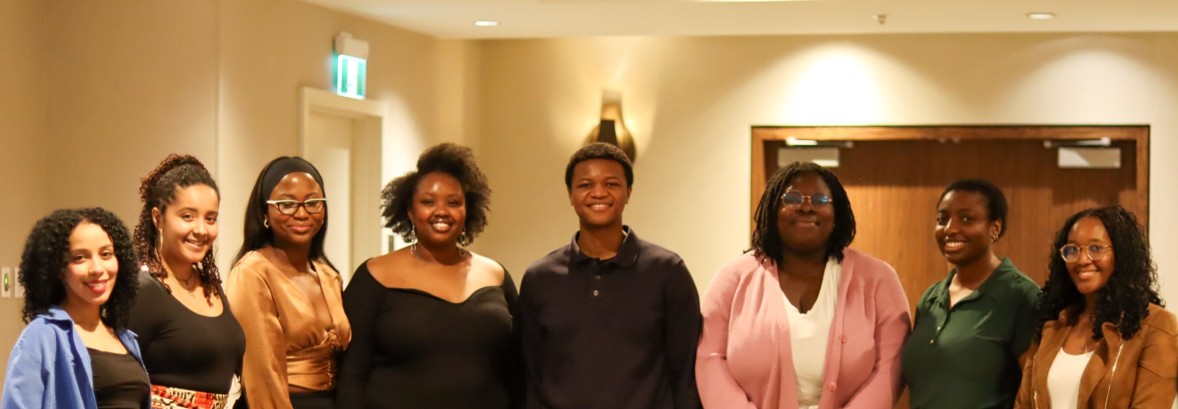
Spotlight on the Black Medical Student Association
Two MD student representatives from the Black Medical Student Association (BMSA) chapter at USask’s College of Medicine sat down to talk about the student-led group, its purpose, achievements, current initiatives, and upcoming events.
By Wren MynhardtBuilding community, creating avenues for learning, and advocating for improved care are just a few goals of the Black Medical Student Association (BMSA) chapter at the University of Saskatchewan (USask). The organization, which was founded in 2020, started as an informal community that grew into a ratified group in 2021. Their purpose: supporting Black medical students and Black health care.
“We aim to support the growth and vitality of Black medical students,” said Larisa Oncea, BMSA’s co-president and a third-year MD student. “We support pre-med students too, create learning opportunities, create community, and try to ensure that the broader medical student body is a culturally safe social and learning environment.”
When asked about the chapter’s guiding values, Aluk Geu, BMSA’s co-president, a second-year MD student, shared, “Medical student support, community outreach, and political advocacy.”
The BMSA chapter at USask began after the Black Medical Student Association of Canada (BMSAC) launched in 2019. The BMSAC is overseen by Black medical students across Canada and today has over 400 members across the country. USask’s College of Medicine chapter has members based in both Saskatoon and Regina.
“When it comes to individual chapters, they are slightly different in terms of what they do. In Saskatchewan, we have a small population in general, let alone a small Black medical student population,” said Oncea.
She continued, “It can be quiet isolating for Black learners. There is still quite a bit of racism learners, physicians, and patients face. We want to ensure there are avenues for our Black learners to talk about that, report them as needed, and develop pathways for growth and learning in the broader UGME community.”
One of the biggest accomplishments of USask’s BMSA is encouraging the creation of the Black Student Admissions Pathway at the College of Medicine. The pathway requires that students who apply through this avenue write a personal essay to supplement their application. Later, after the MMI [multiple mini interviews], Black applicants are assessed by a panel comprising of a Black medical physician and a Black medical learner. The pathway was introduced in 2025’s application cycle for entry in 2026.
“We really encouraged the university that the Black student pathway was an important step other schools found success with,” said Oncea. “It aligns with the calls to action the College of Medicine set out of connecting, embedding EDIA principles, and reflecting and learning. We are super excited that this year was the first year it was implemented.”
Another recent contribution of the BMSA, in partnership with the Division of Social Accountability, was the creation of a half-day workshop for MD students specific to Black health, which provides learning that is missed in standard curriculum.
“The curriculum still largely misses talking about Black health, and how [health] outcomes differ for Black populations,” said Oncea. “We worked really hard on [the workshop] last year for third-years to increase their knowledge and awareness to help promote a better environment for future patients and students.”
Other local events that the BMSA has hosted include Q&A sessions for Black pre-med students regarding panel interviews, movie nights that include themes of Black health and Black culture, and trivia nights based on Black health and research done by the Black medical community.
“We also had a health care panel where we had a variety of Black health-care workers talk about pathways to medicine and health care,” said Oncea. "We’ve also had some social nights where we just hangout, have fun, and create a safe space for people to be Black and proud and not have to think about everything else in the world.”
USask BMSA members have also taken part of events hosted by the larger BMSAC organization.
“There’s an annual general meeting with the BMSAC every year that at least a few of us try to attend. It’s not just about safe community in the broader context of across Canada, but a lot of insightful talks about new research highlighting Black specific care and motivational talks about how to process and deal with racism in health care,” said Oncea. “[It gives] really powerful tools in dealing with that and protecting ourselves and our patients.”
The general meeting also includes learning sessions that look at improving patient outcomes that are backed by medical research and emerging evidence. One of these sessions included care for Black patients with sickle cell anemia, something that excited both Oncea and Geu.
Reflecting on one of the things she learned, Oncea said, “It’s really helpful for [Black] patients currently with sickle cell to get blood from Black donors. Yet, we don’t have a lot of Black donors. One of the things was talking about ways to organize blood drives within the Black community. We were given resources for people to contact and things like that. They’re very useful tools for seeing what other places are doing and how we can bring that to Saskatchewan as well.”
“For me it was educational to have that talk because I went through a module on HEME/ONC [hematology and oncology] and we were told there was management but no cure,” said Geu. However, during this informational session, she learned that a cure did exist. “That’s very important to know because a majority of cases come from the Black population. It’s highly stigmatized and until then, I thought it wasn’t curative. It’s mind blowing to know there is a cure.”
Geu went on to add, “So much research comes out of the Black Physician Association, and a part of our responsibility is to seek that out and go to things like this where its disseminated.”
The BMSA at USask currently is planning for panel interview preparation to take place around mid-March. They are also collaborating with USask on an Afro-voice futurism exhibit. The exhibit will take place in Regina and feature photography projects that tell a story of envisioning Black health and Black futures in different fields.
Geu said, “I did two pieces at the end of my first year…I came out with all my experiences, but I hadn’t processed them yet. It’s what I experienced with my colleagues, learners, patients, with people above me in medical education, and UGME.”
She added, “I got to produce how I saw our futures as patients and medical professionals.”
“It’s super important not to talk about just Black struggle, but Black hope,” Oncea emphasized. “The point of the exhibit is to focus on hope and our strength and resilience.”
The BMSA is planning to do a cultural potluck later in March.
“Food is great and brings people together,” said Oncea. “[The potluck] would be open to all medical students and just share a variety of different Black cultural foods.”
Reflecting on the BMSA at USask near the end of the interview, Geu and Oncea were asked if they would like to share reasons for joining the BMSA, and what their favourite memories are so far.
“When I was applying to med school I had seen the BMSAC AGM on social media and they looked like they were having fun,” said Geu. “I Googled them and saw a chapter in every school. I thought, ‘when I get in, I’m joining the BMSA,’ and reached out in my first week.”
Thinking of her favourite memory, Oncea said, “My favourite hands down is the BMSAC AGM from 2025…It was honestly one of the best weekends. I learned so much. It was really meaningful to not feel so isolated in the community and see how many of us are out there.” She added, “From that I still have people I talk to across Canada…having something tangible for me to experience was really meaningful.”
In the future, the BMSA is looking at finding more funding sources.
“Other BMSA chapters tend to have organizations that fund them. It would be nice if we also had sources of funding,” said Geu. “Because we’re at different sites, the events are smaller and not as great as when we are all together. The cost of meeting up comes out of pocket. We still have to fund a lot ourselves. I’m hoping...we can find organizations looking for student groups like this to support.”
Membership for the BMSA is reserved for Black medical students. For others who wish to get involved, they can volunteer for opportunities such as setting up events. “If you’re part of another student group that you think a collaboration would be fun or educational, then reach out to us,” said Oncea. “We really appreciate other student groups or students who have been doing advocacy work.”
She went on to add, “If it involves the Black community, reaching out to us for our input is important. It only strengthens our goals as we work together.”
The Black Medical Student Association (BMSA) chapter at USask was ratified in 2021. For those seeking more information, you can follow their Instagram usaskbmsa or email uofs.bmsa@usask.ca.