
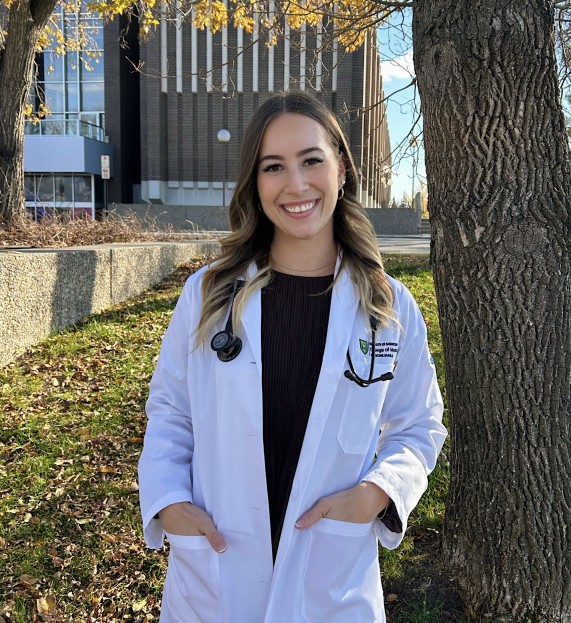
Award-winning USask student reflects on her path to medicine
Brianna Andrews (she/her) is a third-year student in the MD program at the College of Medicine. Recently, she won several awards at the Fall Formal. She sat down to talk about how she came to medicine, and the key to her success.
By Wren MynhardtMeet Brianna Andrews (she/her), MD Class of 2027. Andrews received not one, not two, but seven awards at the 2025 Fall Formal. Among these were the Reuban Brant Scholarship in Medicine bestowed based on academic merit, and the Dean’s Award in Medicine granted to a student with an outstanding contribution that cannot be evaluated by traditional means.
Originally from Saskatoon, Andrews first completed a Bachelors of Kinesiology at the University of Saskatchewan (USask) before taking a year off to both travel and take part in research. Eventually, her path led to her applying to the College of Medicine for the MD program.
“I don’t necessarily have a straightforward path or determining factor that brought me to studying medicine. It was a few things,” said Andrews . “What first sparked my interest is my health history. I have CML—chronic myeloid leukemia… I was fourteen and learning who I was and what I wanted to be, and that exposure to the health field got me interested.” She went on to add, “As a student-athlete and being involved in research in my undergrad, I worked with different people and providers in different environments. Every endeavour and interaction offered something unique, which I appreciated, and it all fit together to lead to medicine.”
Andrews still actively engages in research when given the opportunity. Two instances came to mind when asked about her favourite projects so far: “I was recently involved in a project with the Saskatchewan Cancer Agency looking at myeloid malignancies, the same family [of cancer] as what I have. We looked at survival outcomes following bone marrow transplant in individuals with a specific type of mutated acute myeloid leukemia or myelodysplastic syndrome.”
Andrews primarily worked with patient charts and reviewing patient histories which resonated strongly with her. “Research is slow when looking at these nuanced topics. They’re important for understanding what gaps exist so changes can be made to support [patients’] quality of life.”
Improving patient care was a central theme in Andrews’ other favourite research experience. Last summer, she took part in a Dean’s Summer Research Project. The project focused on patient needs regarding organ donation and transplantation. As part of her work, Andrews heard many stories from both patients and their families.
“It’s hard to put a word to the gravity of the situation when people were so trusting and willing to share their experiences. I want to improve these patient experiences. They should always be at the forefront of your approach.”
As seen in her research endevours, providing exceptional patient care is key to Andrews and her approach to medicine. Now in her first year of clerkship, she is enjoying working more in hospital and clinical settings. “The impact we have on patients even as a learner has stood out this year, and it’s a wonderful thing to be a part of.”
Looking ahead to the future, Andrews is undecided as to what her final path will be. “I am still open which is a bit nerve wracking and exciting at the same time. I know I want to focus on women’s health—whether that be through family medicine with obstetrics, or through obstetrics itself, or even hematology. I just did an elective in hematology and it was a fantastic two weeks. Being able to puzzle your way to a conclusion was fascinating.”
In regards to how Andrews has achieved such success in her medical schooling so far, she credited finding flexibility and balance. During pre-clerkship and in her undergrad, Andrews was part of the Huskies track and field team as a sprinter.
“Being a student athlete has taught me the discipline to balance multiple interests. Setting priorities is essential. There are so many demanding aspects of academics and life in general, so realizing what areas to put first and when to take a step back was helpful for me.”
She later stressed, “Filling your own cup and nourishing yourself is also important. Whether it’s engaging in past interests or discovering new ones, being able to step outside of medicine supports your well-being. Find your joy and follow your passions—you’ll find ways to fit everything in without overextending yourself.”
At the end of the interview, Andrews remarked on advice that she would give herself before starting her first year of medicine.
“Being comfortable in being uncomfortable… Giving myself grace to adapt to the demands of medicine and recognizing there isn’t one path to success. If that was something I acknowledged a little earlier on, some of the intrinsic weight I put on myself would have been reduced. Enjoy what you’re doing, put in the work, every step is one in the right direction.”