
Identity, Access, and Equity: The Medicine Chest Award in Indigenous Virtual Health
Dr. Jarol Boan speaks about The Medicine Chest Award in Indigenous Virtual Health, the importance of identity and patient access in healthcare, and how medical students can contribute to reconciliation.
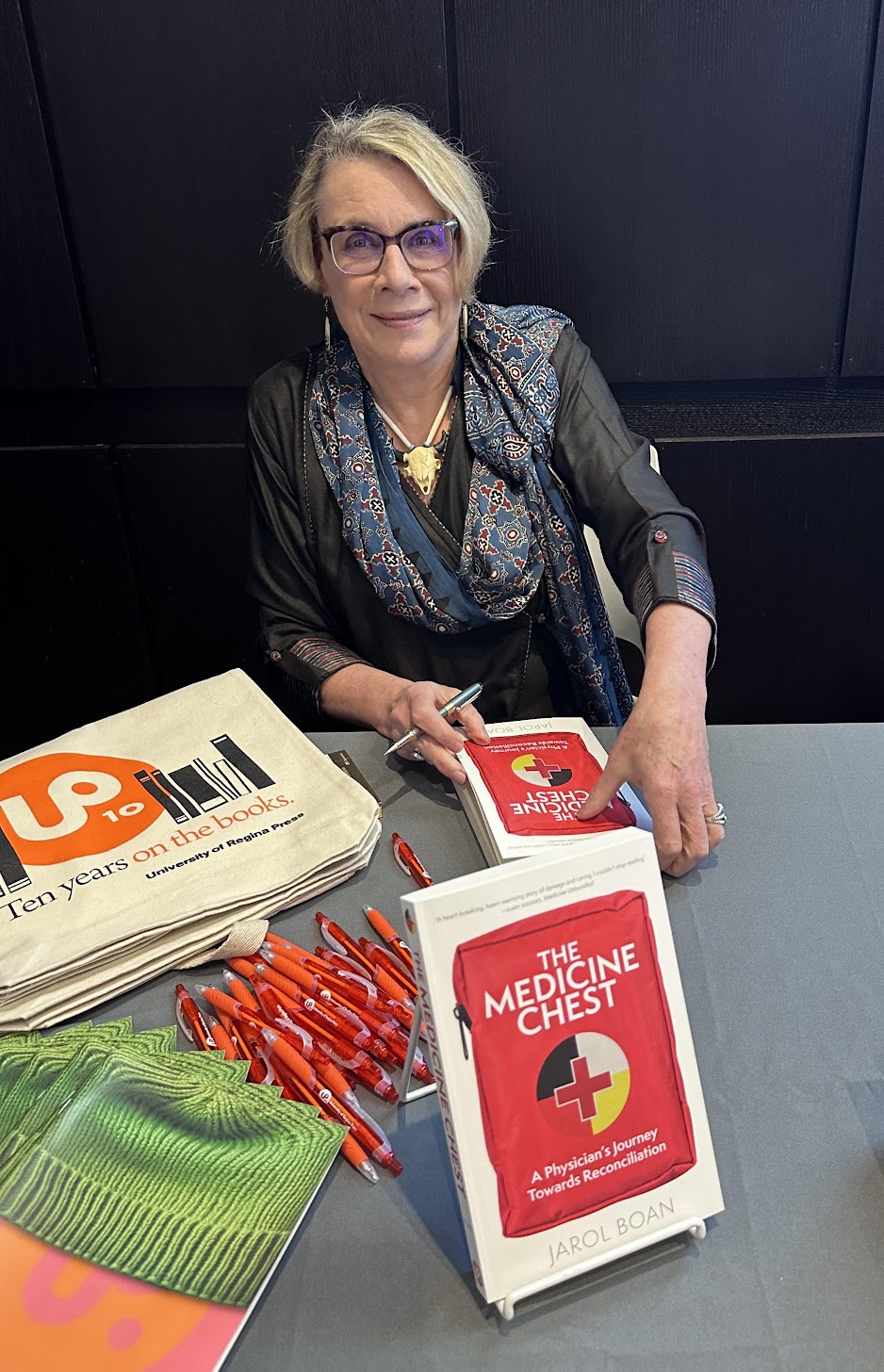
By Wren MynhardtThe Medicine Chest Award in Indigenous Virtual Health was established by Dr. Jarol Boan (MD), medical practitioner and author of The Medicine Chest. The award is granted to a student who demonstrates an intention to learn the clinical and cultural aspects of Indigenous health. Recipients must also intend to utilize remote and virtual programs to address barriers to health-care access for Indigenous Peoples of Saskatchewan in their future practice as a pathway to reconciliation, reciprocity and advocacy.
Boan established this award to support medical students who have a passion for health equity. Her own practice and support for health equity stems from ideas of identity, patient experience, and how it impacts access to health care.
“Part of the reconciliation process is understanding your own identity,” Boan said. Throughout her practice, she came to understand patient identity as well and how it shaped their experiences within health care. This inspired parts of her writing in The Medicine Chest.
“That’s where identity comes in,” she explained. “People share their stories with a doctor…personal, intimate parts of their culture, and the listener must be able to hear the context of the stories."
Much of Boan’s writing is also based on witnessing the health-care system’s current inequity in Saskatchewan.
“I thought we have a universal health care system here. Everybody can get care. And then I started seeing diseases that were in end stage,” said Boan. “They were people that weren’t having access to care…some of the things could have been prevented if they had care earlier in the treatment course. I started asking the question, ‘Why is this happening when we don’t have any financial limitations on [health care]?’ Then I started to notice racism and that sometimes Indigenous people were treated differently than others.”
Not only did this realization influence The Medicine Chest, it was part of the reason she established The Medicine Chest Award in Indigenous Virtual Health.
“The award is about how do we teach, and how do we learn? How do we become open to learning different ways of seeing. I wanted to make sure students had the opportunity to learn more about this.”
Boan has dedicated her work as a physician with the Virtual Health Hub (VHH) to increasing access to health care. The VHH is an Indigenous-led organization located in Whitecap Dakota First Nation, Saskatchewan. The organization seeks to provide health-care access to Saskatchewan’s rural and remote communities through the use of virtual health care technologies, AI, and robotic systems with teams located in the patient’s community.
“I’m working for the Virtual Health Hub and the wave of our future with our remote population in Canada,” said Boan. “The farther north you go, the less population you have, and we have to do something about increasing the access to care. So, having students have that kind of a perspective and being able to learn that new way of doing things I think is really important.”
Boan went on to add, “It follows up on some of the lessons that I share in my book - you need to know how to establish trust, know how to understand that you’re learning from your patients, and that you have to understand their context. I really want students to understand how we can improve access to care and do it in a culturally sensitive way.”
When asked about the value of medical education and where she hopes it will lead students, Boan answered, “Medicine is a calling. We have to teach enough to make [students] competent, but there is an imperative duty to serve those who are disadvantaged. This is part of the oath that we take as doctors.”
As for parting advice, Boan shared to students pursuing medical education: “You have to be open to lifelong learning, to hear, to listen, and have the ability and humility to examine your own privilege.” As a final thought, she added, “Decolonization is a process. It is lifelong. Personally, I constantly learn new things every day.”
Students interested in applying to The Medicine Chest Award in Indigenous Virtual Health can view the award and eligibility within the Scholarships and Bursaries channel in PAWS. More information about award cycles available to MD students can be viewed on the UGME Awards and Funding webpage.