
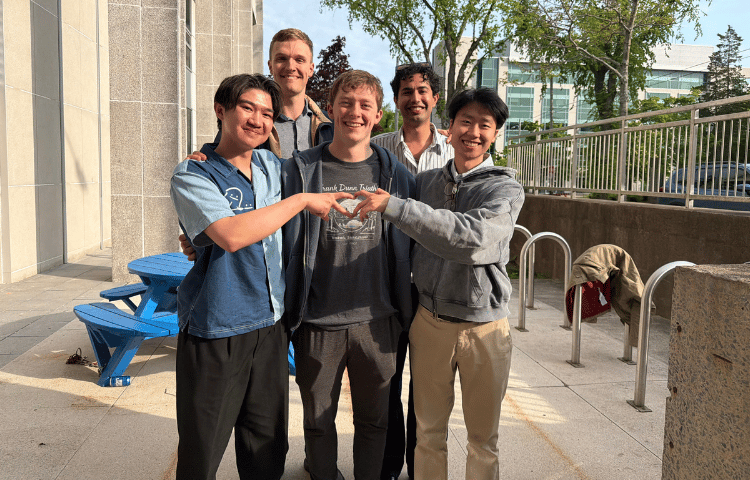
MD students win silver at the 2026 College and University Ethics Bowl
Three MD students, Daniel Ha, Ethan Schultz, and Hamza Saghir, participated in the National College and University Ethics Bowl ultimately bringing home silver. They sat down to talk about the competition and share how studying ethics will help shape their own medical practice.
By Wren MynhardtThere are many ways learners enjoy their summer between terms. Some spend valuable time recharging and catching up with friends and family. Others go travelling for a change of scenery and sense of adventure. Three MD students from the Class of 2029, Daniel Ha (Regina campus), Ethan Schultz and Hamza Saghir (Saskatoon campus), decided to kick-off their summer by participating in the National College and University Ethics Bowl. In the end, they brought home silver securing USask in another top three finish for the second year of this competition along with another USask team who placed first.
The College and University Ethics Bowl was created by Ethics Bowl Canada. It is a national competition which brings in up to twelve teams from across the country. Throughout a period of three days, these teams go head-to-head in debating a variety of topics such as regulating AI companion apps, “correcting” children’s disabilities, and licensing new parents.
“Usually, I find that there’s two types of problems,” said Ha. “There are problems that are quite well-defined, and [that] have previous past evidence and guidelines…and then there's other problems that are more unexplored territories where it's maybe more frontier and you don't really know the correct answer or there aren't previous established guidelines.”
The latter type of problems are the exact kind that interest Ha, Schultz, and Saghir – especially in how it can relate to their own medical training.
“In a way, I think of medicine as applied ethics,” said Schultz. “This competition was a way to engage in very interesting and rich discussions about contemporary ethical topics…It was a nice complement to our academic year.”
“It’s a practical application of things that require a little bit of self-reflection, which is something we’re encouraged to do on our medical journey,” added Saghir.
As MD students, Ha, Schultz, and Saghir are planning to enter a field of professional practice in which they will be presented with cases that will have them determine best care. In some of these cases, they will be faced with differing opinions and ideas from patients or other health care professionals. The College and University Ethics Bowl provides a platform that has teams not only collaborate as individual units, but encourages them to listen and learn from opposing stances. In developing this skill both in training and in their extracurricular activities, Ha, Schultz, and Saghir are building essential tools for future practice.
“It’s important to be really thoughtful and think deeply about these ideas, because even though sometimes these ethical topics might be challenging or uncomfortable, if you have a long career in medicine, at one time or another, you will come into contact with these kinds of situations,” said Ha.
“If there’s a situation where there isn’t a clear guideline or clear precedent, you might have to use a certain critical thinking or ethical framework.”
Saghir added, “It goes back to one of the roles of a collaborator. Trying to talk to people who are maybe not on the same page as you and then trying to find a middle point…[the Ethics Bowl] is very educational and at the same time a very interesting experience.”
This intersectionality between ethics and medical practice is what particularly intrigues Schultz. Previously, he completed his undergraduate degree in philosophy and has his sights set on psychiatry next.
“There’s a fairly well-established pipeline from philosophy into psychiatry, which I think makes sense," said Schultz. "Medical care is political and has a strong ethical dimension. That’s partly why I wanted to become a doctor in the first place.”
Sharing what drew them to medicine as well, both Ha and Saghir spoke about how their desires in addressing hard-hitting problems connect to their desired work as a physician.
“Even the day-to-day interactions and what seems like ordinary problems in medicine is, oftentimes, maybe the most impactful or frightening part of someone's life,” said Ha. “Everything you do matters a lot.”
Saghir shared, “I think it's fantastic that human knowledge has gotten us to this point, that we're able to [help] people…like my other colleagues have mentioned, maybe there's a reason there's a commonality. Like [wanting to be] there for people in those moments which are so impactful…hopefully that will get to be my day to day.”
USask had several teams compete in the College and University Ethics Bowl. USask’s second place team was made up by MD students Hamza Saghir, Ethan Schultz, and Daniel Ha as well as College of Kinesiology student Lucas Le and College of Arts and Science student Samuel Wardell.