
Advancing collaborative care through generosity and service
It began with just $25.
By Kelsey KougiyaIn 1980, still fresh out of training, Dr. David Keegan (MD’64) made his first charitable gift to the University of Saskatchewan (USask). At the time, he could not have imagined that this modest start would grow into a 45-year tradition of generosity and service, one that has supported countless students and reinforced the College of Medicine’s ability to prepare the next generation of physicians. Each gift, and each moment of mentorship, became a steady demonstration of his commitment to the institution and province that launched his medical career.
Today, that same generosity has inspired him to establish a life insurance legacy gift that will create an award for students pursuing careers in family medicine or psychiatry, two specialties in need of practitioners. For Keegan, the culmination of his giving is far more than financial support. It is an evergreen investment in the kind of medicine he has always advocated for: collaborative, compassionate, and firmly rooted in community.
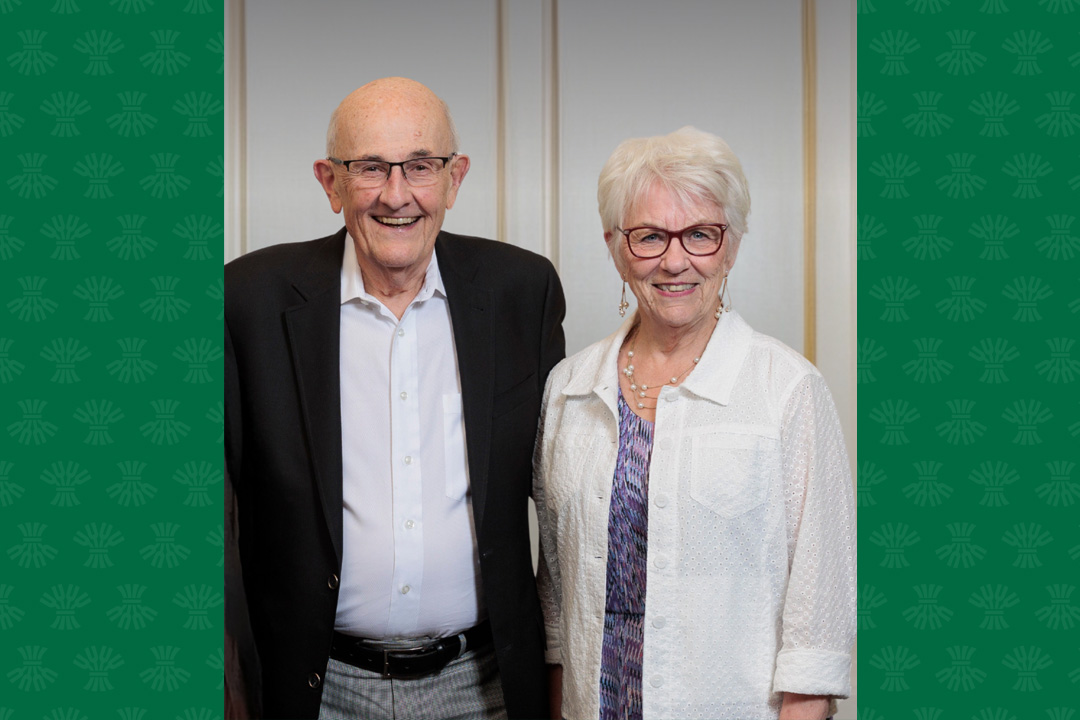
Alongside his professional and philanthropic journey, Keegan’s greatest strength has been his family. His wife, Carolyn, a nurse whose compassion and steadiness make her the quiet centre around which everything turns, has been both his partner in purpose and the anchor of their home. Over the course of her nursing career she took on many roles, including in emergency care, intensive care, and ophthalmology, though she found her greatest fulfillment as a diabetes nurse educator, where she supported patients in managing their health with knowledge, confidence, and dignity.
Her example of care and leadership helped shape the values carried forward by their children. Heather, a dietitian who has practiced in both community and hospital settings, managed food services at the Nipawin Hospital and worked as a diabetes educator before moving into her current role as manager of professional practice with the Saskatchewan Health Authority (SHA). Mark, a professor of neurology at the Mayo Medical School and a neurologist at the Mayo Clinic in Rochester, Minnesota, where he, specializes in multiple sclerosis and autoimmune neurology. Laura, a social worker, whose career has included frontline psychosocial work with the Canadian and International Red Cross, including service in Sierra Leone during the Ebola epidemic. She later applied her expertise at HIV Edmonton to support people living with HIV, and she now manages the KidsFirst program in Saskatoon for the SHA. Together, their paths reflect a shared commitment to service, care, and community that lies at the heart of the Keegan family.
His philanthropic commitments to the College of Medicine mirror the values that have defined his career. Keegan’s relationship with the college began as a medical student, where he first recognized the critical link between family medicine and psychiatry. That understanding deepened during a psychiatry rotation with Dr. Griff McKerracher (MD), then head of the Department of Psychiatry, who championed the idea that mental health care must be closely integrated with family practice to meet the needs of patients facing mental illness and addiction. The insight that care is strongest when disciplines work together became a cornerstone of Keegan’s professional philosophy. It was a philosophy he carried into practice from the very beginning. Early in his career as a family physician in Estevan, Saskatchewan, he provided care for individuals transitioning from the nearby Weyburn Mental Hospital back into the community.
This was no simple task, as these patients often required ongoing psychiatric support, medication management, and help reintegrating into daily life. With the steady guidance of Weyburn psychiatrists, Keegan successfully integrated them into his family practice, creating an early and practical model of collaborative care that offered dignity, stability, and favorable patient outcomes.
As his career in psychiatry progressed, Keegan became increasingly committed to care models that placed patients at the centre. He worked side-by-side with family physicians and mental health professionals to design coordinated treatment plans, ensuring that no one was left navigating the system alone. He particularly valued his time traveling to rural clinics, where he offered psychiatric consultations, provided continuing education for family physicians, and coordinated with community psychiatric nurses serving as case managers. These efforts not only built local capacity but also reduced wait times and allowed patients to receive timely care closer to home.
Later, he embedded himself directly in family practices, visiting biweekly to consult on patient cases, lead one-on-one and group learning sessions, and model collaboration for both family physicians and psychiatry residents. This approach allowed mental health expertise to be shared in real time and in real settings, while reinforcing the message that collaborative care benefits all involved: patients, families, and practitioners alike.
Forty-five years after that first $25 gift, Keegan’s contributions, both in philanthropy and in advocating for collaborative care, remain guided by a simple truth: when physicians work together, patients and communities have a healthier future. His legacy is one of generosity, vision, and an unshakable belief in the power of collaboration, a legacy that will continue to positively shape the USask College of Medicine for decades to come.