
Young Innovators: Exploring the health and wellness of Indigenous leaders
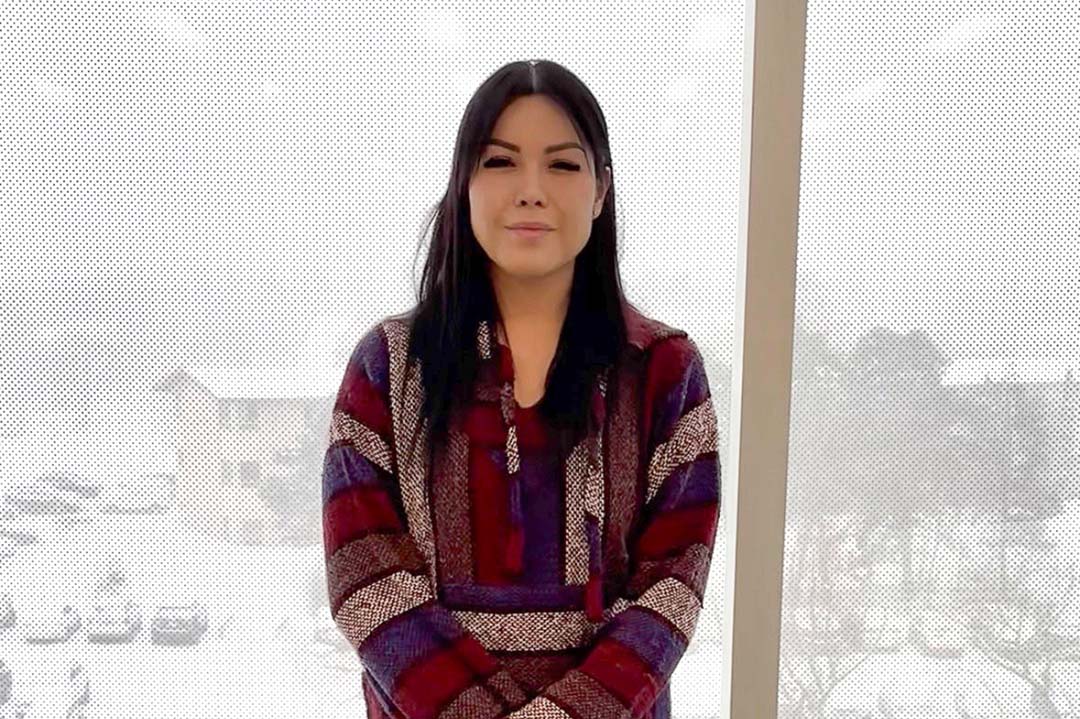
University of Saskatchewan (USask) graduate student Sheila Naytowhow was raised by First Nation elected officials and saw first-hand how their leadership roles impact their health.
By Erin Matthews, Research Profile and Impact“My late grandfather was a Chief in our community but unfortunately, he passed from a brain aneurysm when I was a teenager. He was only 53,” said Naytowhow. “The health of my family started off as the main driver for my research but, as I progressed, my focus now extends to future generations and leaders.”
With a background in business and psychology — Naytowhow received her bachelor’s degree in psychology from the College of Arts and Science and a graduate certificate in leadership from Edwards School of Business at USask— she wants to understand how First Nation elected officials experience and derive meaning from their leadership roles. As a master’s student in USask’s College of Medicine, supervised by Dr. Shelley Kirychuk (PhD), Naytowhow is particularly interested in how these experiences impact their overall wellbeing, including their physical, mental, emotional and spiritual health, both positively and negatively.
“I want to understand the experience of First Nation elected officials from their perspective, without clouding it with my interpretation as a researcher. To achieve this, I had to develop an approach that prioritizes Indigenous worldviews,” said Naytowhow.
To ground her work, Naytowhow turned to descriptive phenomenology, an area of study that examines people’s experience in the world. Originally developed by philosophers of the late nineteenth and early twentieth century, phenomenology is now used as a health research method.
“To build my framework, I studied phenomenological philosophers of Germany and France, particularly the work of Maurice Merleau-Ponty. I was really interested in ideas that take a more holistic approach which includes both mind and body to understanding the underlying meaning of an experience.”
Despite some similarities, Naytowhow had concerns with the ways that current phenomenological methods focus on attaining a universal meaning of experience, which includes excluding one’s cultural context and history. Naytowhow saw an opportunity to develop a new method, one that captures the meaning, or ‘essence’ of an experiences, while also more culturally inclusive to honor participants own worldviews.
“My approach was to create a new innovative phenomenological method, one that really focuses on how a particular phenomenon affects one’s spiritual, emotional, mental and physical health — essentially infusing it with an Indigenous worldview which, to my knowledge, hasn’t been attempted before,” said Naytowhow.
A key aspect of Naytowhow’s work also focuses on intergenerational relationships, asking participants to offer advice for future First Nation elected officials based on their own experiences. This kind of knowledge transfer can help prepare Indigenous youth for future leadership roles.
Naytowhow has seen a lot of support for her work from the academic community and from Indigenous leaders across Canada. She has received funding for her research through the Canadian Institute of Health Research (CIHR), Saskatchewan Health Research Foundation (SHRF) and Saskatchewan National Network Environments for Indigenous Health Research (SK-NEIHR).
“My research involved many cycles of back-and-forth thinking, trying to determine what makes sense and what doesn’t. Sometimes I feel like I’m a sculptor, moving around this large piece of art, ensuring parts are connected smoothly. It hasn’t been easy, but it’s been worth it,” said Naytowhow. She plans to continue her work by pursuing a PhD which would help her expand her research from a pilot project to a full-scale phenomenological study.
This year, Naytowhow had the opportunity to present her research at the National Gathering of Indigenous Graduate Students in Banff, Alberta and was awarded a Certificate of Excellence by the CIHR Institute of Indigenous Peoples Health for her work.
“I wouldn’t be here without the support and encouragement from my research advisory committee and SK-NEIHR. They have really supported me, believed in me, and have helped me develop a clear vision. I hope my work can contribute to shaping policies on holistic health for Indigenous people in the workplace, while also supporting our future leaders to thrive holistically in their roles through a deeper understanding of past and current leaders’ experiences,” said Naytowhow.