
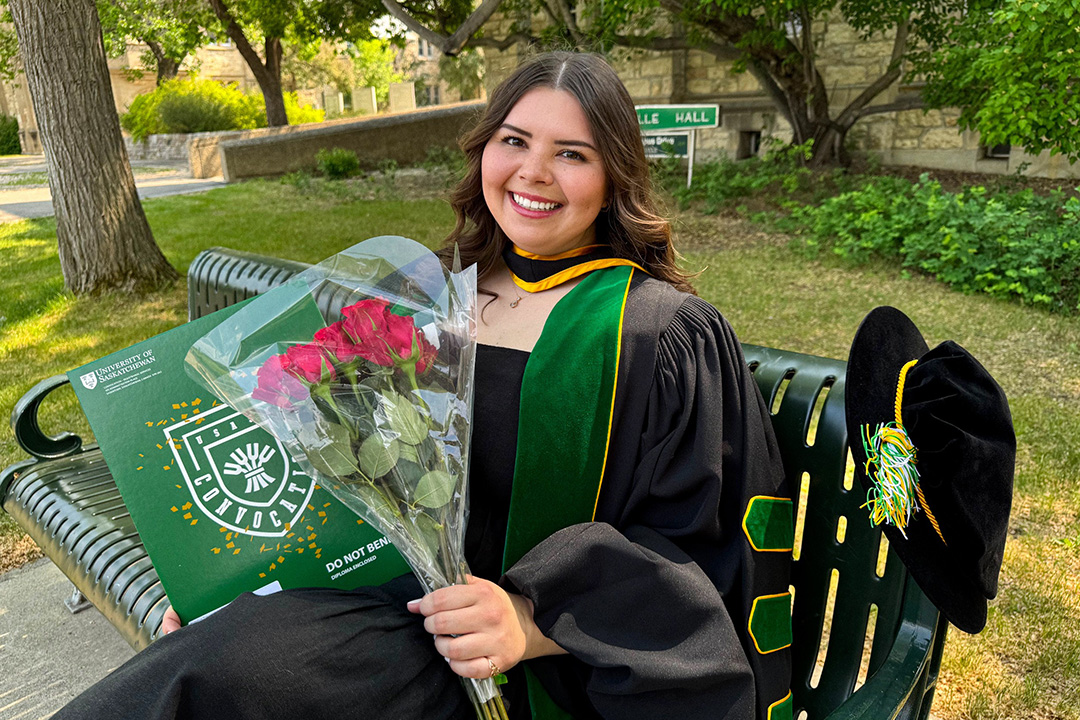
The journey to investigate a new therapy for multiple sclerosis
During her undergraduate degree, Dr. Nataliya Tokarska (PhD) realized she had an interest in neuroscience.
By Trenna BruskyThis led her to Dr. Valerie Verge (PhD) and to investigate acute intermittent hypoxia (AIH) as a non-invasive therapeutic approach for multiple sclerosis (MS).
MS is a progressive inflammatory, mostly autoimmune disease that causes inflammation, demyelination (damage to the protective cover of nerves), and neurodegeneration. Approximately 2.9 million people are affected worldwide—and Canada has one of the highest rates in the world.
AIH provides brief, controlled exposures to low oxygen air alternating with normal oxygen air. The team found this approach could promote repair in a widely used animal model of MS.
Their most recent paper builds on their earlier findings and continues to highlight AIH as a promising novel, non-invasive therapy that may support myelin repair and neurological recovery in MS in both sexes.
We asked Tokarska about her path through graduate studies, and what is next for this research and for her career.
Can you tell me about yourself and your journey as a student?
I was born in Ukraine and moved to Canada with my parents when I was really young. We originally lived in Ontario but moved to Saskatoon right before I started high school. Coming from an immigrant family, education was important because my parents made a lot of changes to their lives to be able to come to Canada and to pursue a better future.
I had an awesome science teacher in grade 12 who was really passionate about science and made it a lot of fun—I think that's one of the reasons I really enjoyed science. Going into university, I knew that I wanted to pursue science and chose to do a bachelor’s in biomedical sciences.
For a while I went back and forth between going into health care related work or pursuing graduate studies. However, during my undergrad I also did a minor in psychology and realized that I really liked neuroscience. After I finished my fourth year, I looked for opportunities for master’s programs that were neuroscience based. At the time, there wasn't a specific neuroscience program at USask, but there were a couple researchers doing neuroscience work and Dr. Valerie Verge was one of them.
A lot of the work Dr. Verge was doing involved a technique called electrical stimulation for nerve repair and regeneration. Just as I came into the lab, she was switching focus to a non-invasive therapy called acute intermittent hypoxia (AIH).
AIH is a type of therapy that involves controlled exposure to low-oxygen air (hypoxia condition). A machine is used to switch from a low oxygen environment to a regular oxygen environment for a certain number of cycles.
When I started, I was the only student in Dr. Verge’s lab and was involved in this completely new MS-focused project. We worked with Drs. Gillian Muir and Michael Levin’s teams, to establish the AIH treatment setup and the mouse model of multiple sclerosis (MS) called experimental autoimmune encephalomyelitis (EAE).
Can you tell me more about your research?
My project involved testing AIH as a potential therapy for MS. During my master’s degree I did a lot of research examining whether and how AIH induces repair and reduces inflammation in female EAE mice. I finished my master’s during the COVID pandemic, and Dr. Verge gave me the option to continue into a PhD primarily because of the tremendous therapeutic potential of AIH that was unraveling.
As MS affects both sexes, our recent research involved replicating our earlier studies but now using male EAE mice. Our new paper in Glia, shows really promising effects—very similar to what we saw in our female EAE mice.
Our work showed that AIH induces impressive repair and significantly reduces inflammation. It also changes the immune system towards a pro-repair state instead of a pro-inflammatory state.
My postdoctoral research is focused on looking into the potential cellular and molecular mechanisms through which AIH exerts its effects. The goal is to understand how AIH promotes repair in the EAE mouse model and how these pathways might be optimized for therapeutic use.
What is the most exciting thing from your research?
The most exciting thing is that in our EAE model we found AIH can induce repair within the central nervous system after there has already been a lot of damage caused by the disease.
A lot of available MS treatments target improving symptoms or slowing down the disease. However, there are not a lot of treatments that target repair and recovery of function in people with progressive MS that already have a lot of damage in their central nervous system.
Because of what we have seen in our research, we hope that AIH could help repair and prevent loss of function in people with MS where damage is ongoing, especially as the disease enters the progressive phase. In addition to identifying the mechanisms that AIH works through, we are also extremely hopeful that AIH human clinical trials for MS will be a reality in the near future.
What is next in your journey?
Coming out of my PhD, I stayed in a postdoc position with the same supervisor—which is wild to some people. A lot of the time, if you stay at the same university, let alone the same lab for a postdoc, it's kind of looked down on. But this research is very near and dear to my heart. Being able to go through the research from its inception, through all the steps to where it may enter clinical trials has been a really cool and unique experience.
Moving forward, I am looking into branching outside of the day-to-day bench research. However, I would really love to remain within a research or academic role, maybe in a research administration position or as an instructor. I currently teach a few courses at Saskatchewan Polytechnic and Gabriel Dumont Institute and find it really fulfilling.
What tips do you have for students looking to pursue the field of science?
You really need to have a desire to take the science path. It's a lot of hard work. I think a lot of people don't realize that when they're coming out of a four-year bachelor's degree. Getting a graduate position, either a master's or PhD, is difficult in the first place. You have to be vetted by supervisors and you have to get funding.
And then in addition to that, you need to be able to persevere. A lot of things can go wrong in science and there might not always be a positive result in your work. But you still need to stick with it because any research, any type of data is important and it's important to get it out into the world. Even if it is negative findings.
The last thing I want to say is that you learn so much in graduate school that is not academics related. You learn many skills, whether that's communication skills, being able to handle multiple responsibilities at once, or building relationships and working with multidisciplinary teams. It's a really awesome experience and those skills you learn can be used in many different aspects of your life.