
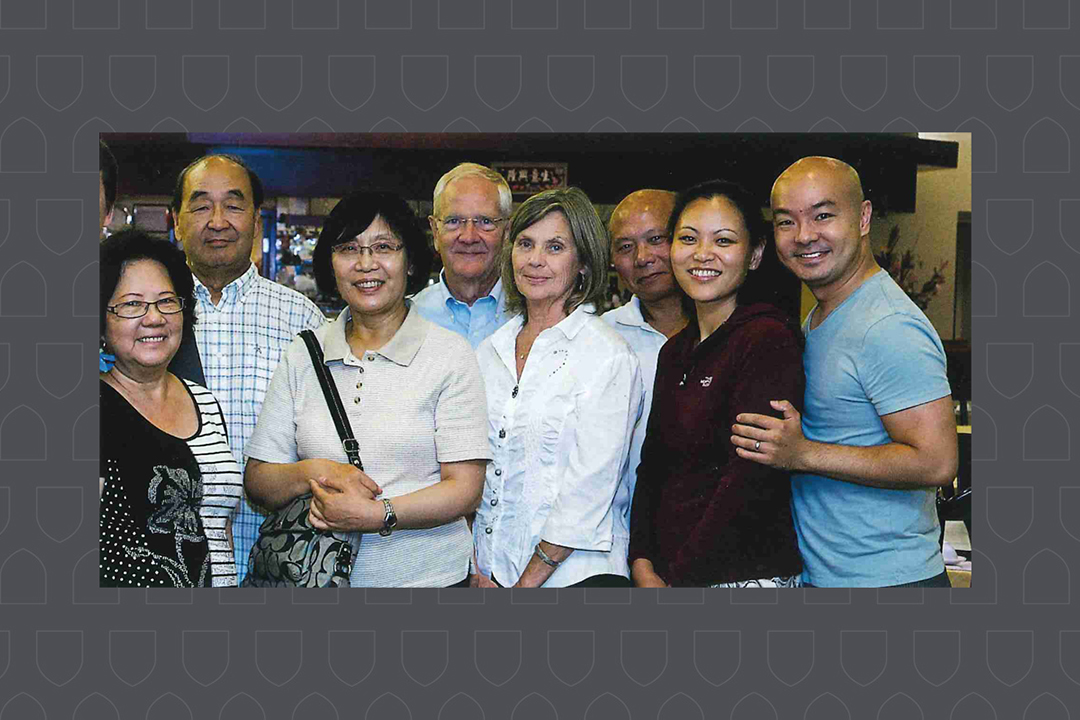
Dr. William Albritton
Dean, College of Medicine, 2002–2012
Published in Connective Issue; Spring 2013
"Colleges are complex adaptive systems; it's hard to predict outcomes," Bill Albritton says. "Leaders have to be able to respond to unanticipated outcomes very quickly and in ways that will sustain the college." Bill speaks from experience, having led the University of Saskatchewan's College of Medicine through 10 challenging years.
Bill is no stranger to conflict and unrest, having grown up in the southern United States in the '60s. He and his wife, Betty, first moved to Canada in 1975. Bill describes it as a breath of fresh air, and he and Betty resolved to become Canadian citizens if the opportunity arose.
Bill spent 30 years in academia in Alberta, Manitoba and Saskatchewan as well as seven years in private practice in the United States. His personal passion was public health, and he completed three tours of duty with the US Public Health Service. He "fell in love" with infectious diseases while working at the Centers for Disease Control in Atlanta and with general pediatrics while in private practice.
Bill's experience in both the Canadian and US medical systems, as well as his involvement in private practice, academia and public health, helped guide his thoughts about the issues and problems faced by the college over the years.
"Medicine is the only health science in which clinical faculty members are full-time health practitioners," Bill explains, creating an underlying tension between academia and service delivery. In addition, as the college expanded its focus to include the whole province, with activities in Regina, Prince Albert, Swift Current and other centres, it was hard to meet the clinical demands in Saskatoon, and the relationship between the college and the Saskatoon community needed to evolve.
Bill met each new challenge as it arose, but he began to feel increasingly alienated from his colleagues and the university as a whole during the recent strife over the Concept Paper on Academic Organization and Administrative Alignment. Needing to reconnect with the college on a personal level, Bill drew on his past experience in the American civil rights movement and asked his colleagues to join him in singing We Shall Overcome.
"There was no other way that I knew to express what I felt from my own personal perspective," he says. Bill's advice to future deans is to recognize that it's "just a job" and not to take it too personally." Remember to be happy," he says. Bill goes on to say, "As a dean, you must move beyond a narrow focus on yourself and your discipline to a much broader focus on the system as a whole."
Bill feels a particular sense of satisfaction as he watches the walls go up for the new Academic Health Sciences building as he was in on the ground floor as the university developed a background paper and established the Council of Health Science Deans. "The different health sciences colleges will be co-located, eliminating some of the barriers to inter-professional education and research," Bill says. "It's so satisfying to witness that level of professional collaboration."
As Dean, Bill particularly enjoyed his interactions with students and alumni. "Betty and I developed wonderful relationships with the students," he says. "It was so satisfying to watch them go on to become outstanding clinicians.”
The development of SWITCH (Student Wellness Initiative Toward Community Health) and Making the Links (a community service learning initiative) aligned with his personal interest in public health, and Bill and his wife went up north every summer to visit the students.
"When I became Dean, there were no Indigenous medical students," Bill says. "There are now over 40 in the program. It's very gratifying.”
Bill's wife was an active partner in many college activities and took a special interest in international students who were completing clinical residencies at the college. When the college held alumni events in other cities, Betty came along on her own initiative, forming relationships and staying in touch with many of the alumni. "My wife is more natural at relationships than I am," Bill says. "She can always remember people's names and details about their families."
Bill remains a faculty member and looks forward to completing research projects into the leadership, structure and makeup of complex systems, especially innovative research environments, as well as different aspects of Canadian history. He received a piano for Christmas, tuned his guitar and is interested in exploring some areas of the arts with his wife.
Along the way, Bill will continue to listen and learn from people's life stories. "In the south where my wife and I come from, we communicate through stories. As Ben Okri, a Nigerian storyteller, says, 'One way or another we are living the stories planted in us early or along the way, or we are living the stories we planted – knowingly or unknowingly – in ourselves. We live stories that either give our lives meaning or negate it with meaninglessness. If we change the stories we live by, quite possibly we change our lives.' "