
From summer student to behavioural neuroscience researcher
Aiden Glass's journey into research began during her undergraduate studies at the University of Saskatchewan (USask), where she gained valuable hands-on experience as a summer student in Dr. John Howland's (PhD) lab.
Now a graduate student in behavioural neuroscience, Glass is building on those early experiences through her own research.
We asked Glass a few questions to learn more about her work, the role mentorship has played in her own research journey, and career aspirations after graduation.
How did you first become involved in research as an undergraduate student and what inspired you to continue into graduate studies?
When I started my undergraduate degree at USask, I wasn’t really sure what I wanted to do with my education, just that I was interested in health sciences. In my first year, I went to a research night hosted by the Department of Anatomy, Physiology and Pharmacology. Two students from Dr. John Howland’s lab presented their work in behavioural neuroscience, which was basically the coolest thing I’d ever heard of. (They had rats sniffing little objects and playing touchscreen games to learn about how the brain works! I still think that’s just incredible.)
Despite being pretty shy back then, I cold-emailed Dr. Howland who is now my supervisor, and to my surprise, he actually responded and was happy to meet with me. I started attending lab meetings, learning about different projects in the lab, and even got to contribute to some experimental work. I really cherished the time I got to spend in the lab and the graduate student mentors who took the time to train and teach me. I still remember the first time I got to section brain tissue and see it under the microscope—I was absolutely ecstatic. I think at that point I was fully hooked.
I ended up doing three summers of full-time research during my undergraduate studies and I dreaded going back to classes every fall because it meant I wouldn’t get to spend as much time in the lab. As I gained experience, I was given more independence and freedom to contribute with my own ideas and direct my own experiments, which made me start to consider pursuing research as a career.
Although there were some real highs and lows within my experiments, my excitement to be involved in science never faded. By the time I finished my undergraduate degree (Bachelor of Science with Honours in Biomedical Neuroscience), I was fully committed to continuing research through graduate studies.
Would you be able to describe your research and current thesis project?
To me, behavioural neuroscience is fascinating because we get to explore how the brain’s microscopic working parts, like specific cells, proteins, and neurotransmitters, interact to shape how an entire animal learns, remembers, and behaves. I have broad interests in the field, but I’m especially drawn to questions about neural circuits in cognition—how cells in different regions of the brain work together to support processes like attention, learning, and memory.
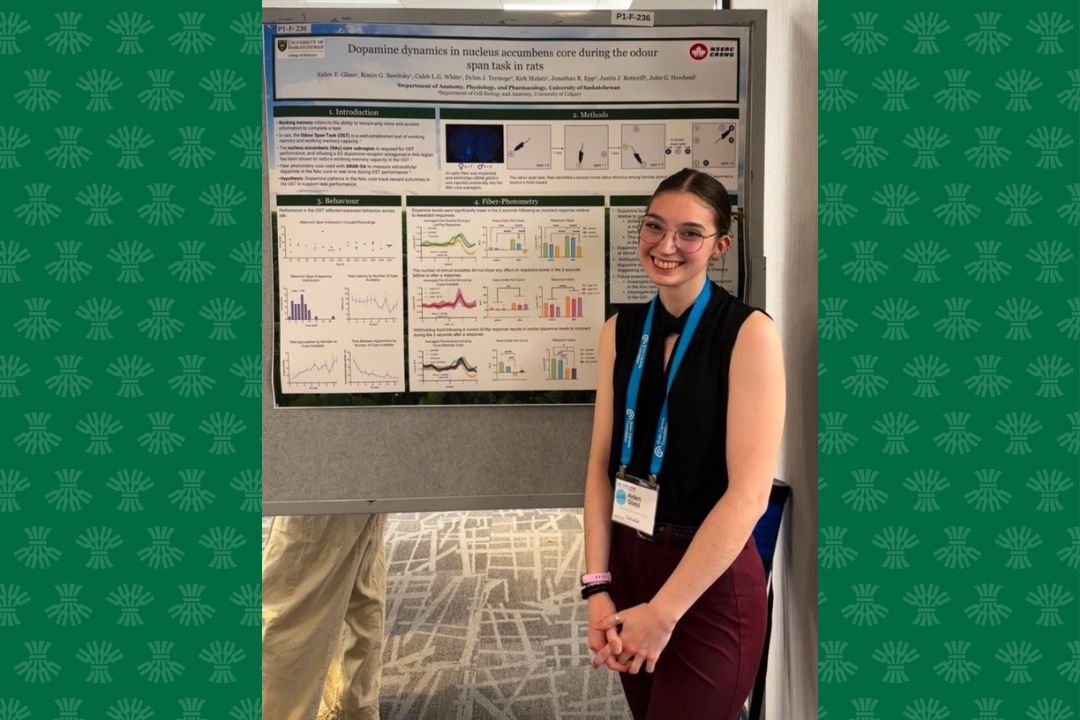
My thesis project is focused on understanding the neural circuits involved in working memory in rats. Working memory is the ability to temporarily store and manipulate information to guide behaviour and is essential for everyday functioning. I use a technique called fiber-photometry to monitor neural activity in real-time while the rats perform a working memory test.
In this test, I use kitchen spices as odour cues and reward the rats when they correctly identify a novel odour among a growing number of odours they’ve already sniffed that day, challenging their short-term memory. Most recently, I have been recording dopamine signals in a brain region called the nucleus accumbens, which is involved in reward processing and decision making. I wanted to understand how dopamine in this region contributes to the dynamic updating of information needed for working memory performance in this task. In my recordings, we see differences in dopamine responses corresponding to the outcomes of the choices the rats make in the test.
Currently, I am planning to use the same working memory task to investigate brain activity in the prefrontal cortex, a key region for higher-order processing, and one that likely works together with the nucleus accumbens to support task performance. Because dopamine signaling in these circuits is altered in many psychiatric conditions, it’s important to better understand how they support healthy cognitive functioning.
What experiences and challenges have had the greatest impact on your growth as a researcher?
I think the single most influential part of my research experience has been the mentorship I received from both my supervisor and the senior students who were in the lab when I was starting out. I had the privilege of working on a variety of projects with people who were so willing to send me learning materials, answer my questions, teach me techniques, and support my interests.
One part of my early experience that stands out was how eager I was to learn as much as I could, so I read papers whenever I had time between tasks. I would be so excited to talk about what I was learning with the senior students in the lab. The discussions they had with me increased my understanding of the work we were doing, teaching me to critically read and evaluate papers, which was huge for me early on.
Since the beginning, I’ve been incrementally and systematically pushed out of my comfort zone, building my confidence to lead projects and teams, present research to academic audiences, and make connections with other researchers in my field. I think some of the most important experiences I’ve had in academia have been some of the most terrifying.
My first year in the lab, I was asked to present in multiple lab meetings. At the time, the idea of presenting in front of the smartest people I knew was incredibly intimidating, but it got easier each time. Now, it’s funny to look back on how stressed I was about things that don’t really faze me anymore. More recently, I was encouraged to present my work at a conference where I didn’t know anyone. Despite my reservations, it was amazing to be surrounded by people who shared similar interests and experiences with me and who earnestly cared to hear about my research project. I’ve come to realize that I not only survive the experiences I’m scared of, but also gain substantially from them.
Last year, when I moved into graduate studies, I took on much more responsibility in my projects and in the lab. Most of the senior students I worked with left the lab around that time, which meant developing my own protocols, training new students, and leading and organizing projects. This transition pushed me to become more independent, but also came with some growing pains, such as learning to handle the inevitable mistakes and setbacks that come with trying to answer questions that haven’t been tested before.
I’ve definitely done my fair share of re-running analyses and troubleshooting technical issues. I’ve learned there’s a lot of things that can go wrong in an experiment, but there’s also a lot of things you can do to correct mistakes or pivot your plans to still gain value from the hard work you’ve done.
You've contributed to peer-reviewed publications and have presented at multiple conferences. Is there a particular research achievement that stands out as especially meaningful to you?
I think my fondest achievement so far is a paper I worked on with a master’s student during my second summer in the lab. The project stemmed from the realization that his rats were “cheating” at a working memory task (the same one I use now) and sought to examine and quantify exactly how those clever little rats were getting around the rules. I was invited onto the project to help with behavioural analysis and manuscript writing, and we ended up sharing co-first authorship.
I had barely done any scientific writing before then, but I learned a lot as my contributions went through the stages of preparation and publication. The project also taught me how important it is to examine the pitfalls of the tasks and techniques we use, like we did in that paper, so that we can do quality science and produce meaningful findings. The observations in that paper are pretty niche, and we aren’t going to win any prizes for it, but I was so thrilled when it got published and I’m still pretty proud of it.
How have leadership and mentorship shaped your research journey, and what advice would you give other students interested in research?
I cannot stress enough how significant a role mentorship has played as I’ve developed in research. From the beginning, I have been very fortunate to receive a lot of support from more senior students, my supervisor, and now my committee. I would not be as passionate and engaged with research as I am now without their influence and encouragement. Of course, I’m still a work-in-progress as a researcher.
As I’m trying to figure out my path in academia, I often feel like a kid learning to ride a bike without training wheels. Some of the things I try might come out pretty wobbly, and I might fall on my face, but I always have supportive people in my corner who help me get back up and keep learning.
I’ve also had the pleasure of being on the other side, training and working with undergraduate students who assist me with experimental work and analysis for the projects I lead. As someone who was an undergraduate research assistant for quite a while and who received some pretty stellar mentorship during that time, I am so stoked when students are engaged with the research, ask questions, and are excited to learn and contribute with their own ideas. This role has pushed me to improve my communication skills in order to teach new students what we do and why it matters, and has made me consider factors I might’ve overlooked otherwise, both of which I can only see as a positive.
From my experience, I’ve learned a few major pieces of advice that I would offer to students interested in research. The first is to try to find what you are passionate about. Research in the absence of passion is miserable. I wouldn’t be able to sustain this work if I wasn’t so genuinely enamored by the research questions I get to find answers to. The other is to take full advantage of the opportunities at your disposal, even if it scares you. Send emails and meet with professors, read papers, learn everything you can about the projects you work on, volunteer to present in lab meetings and journal clubs, and don’t be afraid to ask questions and be wrong.
You never have to be perfect, you just need to show up, be engaged, and learn. Even if what you take from a research experience is that you don’t want to continue that type of work further, that’s still a valuable takeaway in helping you find what fits for you.
What are your future plans after completing your master's degree?
I’m planning to transfer into the doctoral (PhD) program this fall so that the graduate work I’ve done so far will become the beginning of my PhD thesis. I’ve been awarded doctoral funding from the Natural Sciences and Engineering Research Council of Canada (NSERC) to continue my work, and I am thrilled to be doing so. After completing my PhD at USask, my current goals are to pursue post-doctoral research positions at other universities and eventually open my own neuroscience lab as a principal investigator.
It’s definitely not an easy career path; I know it will be challenging and things won’t go exactly as I have them planned in my head, but I think for me it’s worth the pursuit. I’m still pretty early in my career, but even if I fail or change my plans, I’m going to keep following what I’m passionate about, and I don’t want to look back and regret not at least trying to see it through. I genuinely love what I do a ridiculous amount, and I can’t imagine giving it up when I still have so much more to do.