
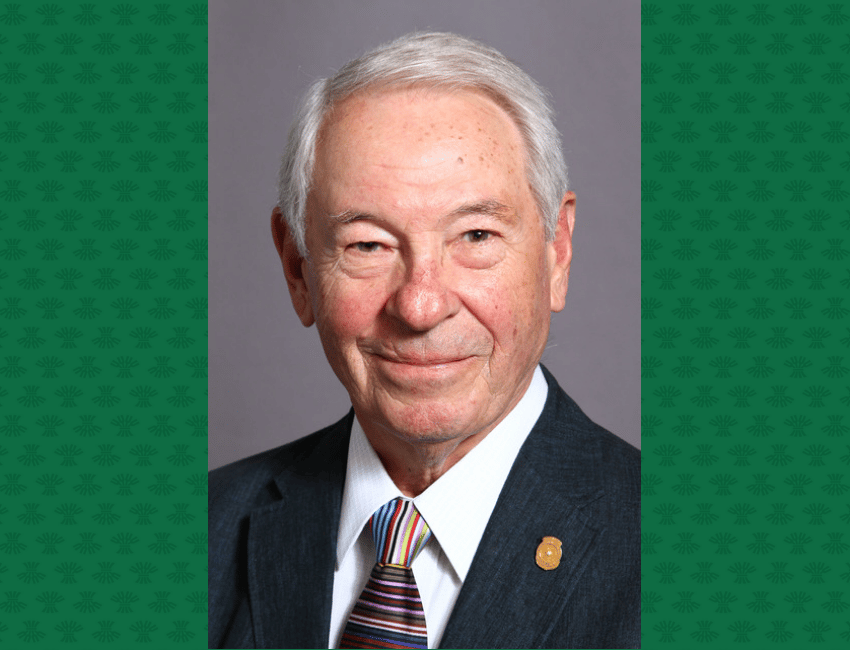
Gratitude and Giving Back: The Dr. Carl J. Zylak Endowed Bursary
USask alumnus Dr. Carl Zylak (MD’62) discusses his purpose as a donor, his time in the medical doctor (MD) program and what advice he would pass on to current MD students.
By Wren MynhardtThe Dr. Carl J. Zylak Endowed Bursary was established by USask alumnus Dr. Carl Zylak (MD) to financially support medical learners. The bursary reflects Zylak’s values of compassion for students, gratitude, and giving back to the University of Saskatchewan.
“What was very important to me was to establish a method whereby funds would be available for medical students who were in financial need,” said Zylak. “Going back to my own background, I would have appreciated those opportunities.”
Zylak is a first-generation Canadian who grew up in the town of Glenavon, Saskatchewan, which at the time had a population of three hundred. “My father and mom had a small business,” he shared. “The competition was pretty brisk with two others... It was a tough way to earn a living. As a result, there wasn't too much loose change.”
When he was a student at USask’s College of Medicine, financial support and resources for new MD learners were limited. “The medical school was pretty young and pretty new then,” said Zylak.
“There was nobody in the med school administration that ever said, ‘how are you doing? Do you need some help financially?’ Those resources just weren't there at that time. I'm forever thankful to the province of Saskatchewan for my ability to gain loans from the Saskatchewan government…They were so gracious in not asking for repayment to begin until one had finished all one's postgraduate training.”
To supplement his student loans, Zylak spent his summer months working a variety of jobs. “I worked on pipelines and installing heating systems and whatever else, like on an oil rig for a couple of weeks…anything to make a few bucks,” he said.
In addition to supporting medical learners, Zylak wanted a way to give back to USask in gratitude of his time here. “That was really [one of] the motivations…to thank the university for giving me the opportunity to become a physician.”
“If one contemplates alternatives, they’re not quite as exciting…and I was very fortunate to select a specialty track that I loved for my entire career, which was diagnostic radiology…If I hadn't gotten into medical school, life would have been a lot different. I’m very thankful to the University of Saskatchewan.”
One of Zylak’s highlights of being a student at USask was the community at the College of Medicine. “We were a very small class,” he said. “I think there was only 30 of us who graduated…you got to know that small group and they were lifelong friends, and ones you looked forward to meeting at the reunions down the road…That was a very important part of the program.”
Zylak also admired the quality of the education he received. At the time, the MD program had only recently expanded to a four-year curriculum. Previously, medical students completed two years of the program before transferring elsewhere to finish their studies. “Dr. McLeod, who was the dean at that time, did a wonderful job in recruiting superb people,” said Zylak. “I'm always indebted to those wonderful teachers.”
After graduating, Zylak carried his values of quality education into his own work as the chairman of the Radiology Department at McMaster University and his tutoring of students for the small group, problems-based learners.
“The hardest thing was to not give the answer,” said Zylak, recalling his time as a tutor. “You had to prod them along. I recall a saying attributed to Benjamin Franklin in terms of learning. He said, paraphrasing, ‘if you tell someone something they'll forget. If you teach them, they will remember, but if you involve them, they learn.’”
He added, “It was always fun to be around the younger folks, and I probably learned more from them than they learned from me.”
When asked about what advice he would give to MD students, Zylak had a few answers. “I think as a professional, you have to be prepared to give back,” he said.
“Giving back can take many forms if you're practicing or going to go into academics because you like to teach or you like to maybe dabble with some clinical research…In that sense, you are giving back because you then end up publishing papers and giving talks nationally, internationally, and so forth.”
“If you choose not to go into academia there are many other opportunities and different ways to give back,” said Zylak. “If you're in a smaller community, get involved with the local rotary, get involved with your local church, get involved with your Saskatchewan Medical Society…In a nutshell, give back because you have been given so much.”
Students interested in applying to the Dr. Carl J. Zylak Endowed Bursary can view the award and eligibility within the Scholarships and Bursaries channel in PAWS. More information about award cycles available to MD students can be viewed on the UGME Awards and Funding webpage.